
LESSONS LEARNED FROM THE 2026 OLYMPICS ABOUT WINNING AND LOSING; AND HOW THEY APPLY TO FAMILY LAW AND FAMILY MEDIATION
Dear Readers,
Happy almost Springtime!
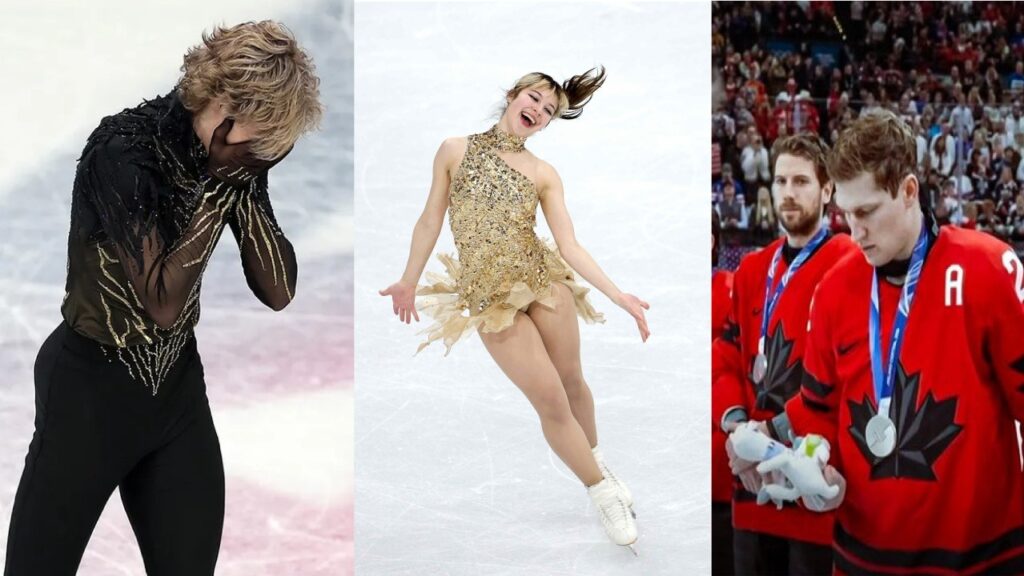
Many of you watched the recent Canada/U.S. Olympic Hockey Gold Medal game. As you know, the U.S. team won Gold and our Canadian team won Silver.
We all saw the sadness etched on the faces of our young Canadian hockey players, and their bewildered “Huh? What’s this?” looks when receiving stuffed animals in the midst of their grief!
Many of you also watched the amazing performance of the young figure skater Alysa Liu, who won gold in Women’s Figure Skating competition. The joy and elation she expressed during her performance will remain in my mind for a long time.
Alysa said, in her interviews, that she didn’t care about winning the Gold Medal; that all she wanted was to skate on Olympic ice, to enjoy her performance and to bring joy to her audience. And yet, despite not caring about the result, she won the Gold!
In contrast, Ilia Malinin – whom many regard as the world’s top figure skater – fell and lost in the most important skate of his life: his skate for the Gold Medal.
The following are my reflections on these events:
- Instead of appreciating their great accomplishment of winning the Silver Medal, Canada’s hockey players didn’t appreciate all the steps they had taken and games they had won against world hockey teams, to get to this final game. They didn’t appreciate that their Silver Medal was indeed a win.
- Ilia, the skater whose face showed from the start of his performance the stress of his goal to win Gold and his focus on this objective, fell and lost.
- Alysa – in contrast – smiled and laughed from the start of her performance and throughout. It was clear that she enjoyed every minute, and, as a result, so did her millions of viewers from all over the world.
The Differences:
- In her performance, Alysa focused on the process, rather than on the result.
- In his performance, Ilia focused on the result rather than on the process.
- Canada’s hockey team focused on the result rather than on the process – i.e. all the steps they had taken and all the wins they had had, to get to the Olympic stage and to win the Silver medal. For them, the only important thing was to win Gold.
How do these lessons apply to Family Law and Family Mediation?
Jane and Ted (hypothetical names) have made the decision to separate. In their first meeting with their lawyers, each of them state, “I want a Divorce.” The focus of each was on the result.
Note: the most important document in Family Law is the Separation Agreement, as their lawyers will explain to them, as it sets out their respective rights and obligations. The Divorce is secondary.
Similarly, in Family Mediation, Jane and Ted, when asked at the first meeting what their objectives are, both state to the Mediator that they want a Divorce.
In this, both Jane and Ted are focusing on the result, rather than on the process.
Mediator Approach 1:
Many Mediators, when mediating family cases, focus on the win. Their predominant goal is to have a result at the end of the day, i.e. a final signed Separation Agreement.
Such Mediators often speed over the necessary steps to get there.
In the result, when the Mediation ends and the Separation Agreement – the final step – is signed by all, the parties are “happy” and the Mediator’s ego is assuaged – as he has added one more notch to his collection of “wins”.
The problem is that, in these kinds of Mediations, in the days and weeks that follow, parties often have regrets about the Agreement they signed. Query whether the terms were what Jane and Ted really wanted, or whether had they been pressured by the Mediator to settle at the end of the day, no matter what!
Mediator Approach 2:
Other Mediators focus on the process. In this, they diligently work through each of the necessary steps with Jane and Ted. Using this process approach will ensure that the final Separation Agreement – the result – will be terms that both parties understand, agree with and are good with. These cases don’t necessarily settle by the end of the Mediation. However, they often settle soon after, as the crucial groundwork has been done in the Mediation. In my Mediations, I use Approach 2.
The Mediators who use Approach 1, often use pressure, intimidation and, sometimes, unfortunately, bullying of the parties in order to get to the result – i.e. a signed Separation Agreement by the end of the Mediation day. The result will be an agreement which one or both of the parties may well ultimately regret.
In my view a successful Mediation requires that the Mediator works with the parties carefully and diligently through each step of the process. In so doing, the result will come – if not by the end of the Mediation meeting – then subsequently in the days and weeks that follow.
Mediator 2’s objective is not to ensure that the parties sign a final Separation Agreement that day, but rather to work with the parties to ultimately sign a Separation Agreement, when they are ready.
With my clients I use the analogy of building a house. The house is built brick by brick, frame by frame. To do otherwise will result in a house that will eventually collapse, as it does not have the necessary strong foundations.
Going back to my Olympics example, a good Mediation is when the Mediator works with Jane and Ted through the Process, step by step. In that way, just as for Alysa Liu in the Olympics, the Result will follow.
When the Process is successful, the Result – a Separation Agreement that both parties feel is their own, can live with, can move forward without regret, and which will stand the test of time – will most likely be accomplished.
In this way, while it may take more time, the foundation will have been built for a strong and lasting Separation Agreement so that Jane and Ted can move on to the rest of their lives with a clean slate (‘tabula rasa!’).
Feel free to contact me if you are interested in using my Mediation services.
Until next time!
Anne
Anne Freed holds a BA (Honours Sociology), JD (Juris Doctor, Law Degree), Master of Laws Degree (LL.M.) in Alternative Dispute Resolution (ADR), Advanced Training in Mediation, Arbitration and Collaborative Practice, Certification in Collaborative Practice, as well as over 38 years’ experience in the practice of Family Law, Mediation and Arbitration. Anne is also a Certified Specialist in Family Mediation (FDRP Med) and an OAFM Accredited Family Mediator (AccFM).
© Anne E. Freed, March, 2026
**************************************